Influence of Mounting Height on Shure Microflex Advanced (MXA) Sound Quality

Shure's official recommendation for maximum mounting height for both the MXA920 and MXA901 ceiling arrays is 12' AFF. The microphone array in the MXA920 is nearly double the size of the MXA901, so a delta in audio quality between the two as mounting height increases makes intuitive sense.

These recordings aim to evaluate the relative difference in change in audio quality as a function of mounting height. Two heights are tested, 9' and 13' AFF. In addition, each height and microphone is tested with both a very quite backgorund noise level and a more realistic, approximately NC 35 background level.

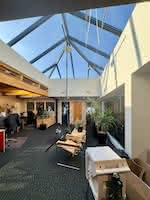
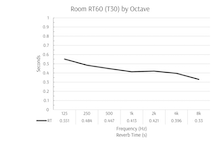
The common area at Richard Dean Associate's Newburyport office features a vaulted glass skylight ceiling reaching 14' at its peak. Despite the glass and hard surfaces, the complex shape of the room and thin carpet keep RT a reasonable 0.4-0.5s. Additional areas openly adjoin to the central area pictured.

Physical Properties

Central Area

24' x 15'

Adjoined Areas

22' x 18' & 24’ x 12’

Heights

7'4", 9', and Up to 14''

Acoustic Treatment

None

Walls

Painted Gypsum, glass

Ceiling

Glass Ceiling in Main Area, Mineral Fiber Tile in Joined Spaces

Floor

Thin commercial carpet

Furniture

Typical office furniture and chairs

Acoustic Properites

Reverb

RT = 0.43s Broadband (T30)

Noise

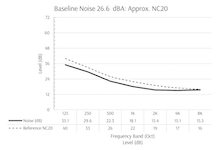
Baseline: 26.6 dBA, NC20 | With Fan: 42.5 dBA , ~NC35

Comments

Small overall volume and complex geometry tame potential for high RT due to predominance of hard surfaces

Acoustic Treatment

None

Acoustic Measurement

Platform

Studio Six Digital: AudioTools RTA and Impulse Response modules Run on M1 iPad Pro

Microphone

Studio Six Digital iPrecision Mic: ANSI Type 1 small diaphragm, omnidirectional condenser measurement microphone

Calibrator

Larson Davis CAL200

Impulse Response

Captured via 18" balloon pop

For the recordings indicated, a small, generic fan provided a typical level of ambient, broadband noise.

Equipment and Processing

Noise Source

Generic fan used in recordings indicated

Processing

NA

Loudspeakers

NA

Loudspeaker Locations

NA

Recorded, dry, female speech was played back through a small loudspeaker at normal seated height and normal speech level exactly 10' from the center axis of the microphone. The loudspeaker was chosen to approximate the sound directivity of a human head. The distance was both a normal talker location in the room and at a typical boundary of recommended coverage area for the array in its automatic tracking mode.

Equipment and Processing

Speech Script

"Harvard Sentences" Script From "IEEE Recommended Practice for Speech Quality Measurements." IEEE Transactions on Audio and Electroacoustics, Vol. 17, Issue 3, 225-246, 1969. APPENDIX C 1965 Revised List of Phonetically Balanced Sentences (Harvard Sentences). DOI 10.1109/IEEESTD.1969.7405210 (IEEE standard 297-1969) and 10.1109/TAU.1969.1162058

Recordings

G. E. Henter, T. Merritt, M. Shannon, C. Mayo, and S. King, “Measuring the perceptual effects of modelling assumptions in speech synthesis using stimuli constructed from repeated natural speech,” in Proc. Interspeech, 2014. Silent audio truncated

Playback Source

VLC Media player to USB audio interface

Loudspeaker

5", coaxial 2-way passive "cube" loudspeaker, low-Z

Loudspeaker Position

48" AFF 10' o/c of the medial axis of the mic array Airmed toward center of table, no tilt

Amplification

15-watt class-D, tabletop amplifier, low-Z

Playback Level

60 dBA @ 1m, 1s ("slow") averaging

Recordings were captured using the Shure Microflex Advanced MXA920 or MXA901 ceiling microphones as indicated. Configuration was selected as detailed below to offer a realistic and largely "default" set of circumstances.

Equipment and Processing

Microphone Mounting Height

9' AFF and 13' AFF

Array Coverage Configuration

Single, Dynamic Auto-Coverage area, 20' x 20'

Equalization (EQ)

High-pass filter: 125 Hz, MXA9xx onboard Intellimix DSP, undefined slope

Compression

None

Acoustic Echo Cancellation (AEC)

Default (MXA9xx onboard Intellimix DSP)

Automatic Gain Copensation (AGC)

On (MXA9xx onboard Intellimix DSP)

Noise Reduction (NR)

To reflect likely real-world configuration, for baseline, no-noise-added recordings, NR was set to "Low". For the fan-noise-added recordings, NR was set to "Medium".

Audio Signal Chain

MXA9xx Dante out to Dante Virtual Soundcard on PC. Audio recorded in multitrack digital audio workstation (DAW)

Recordings

    Baseline - Approx. NC20 Background Noise

    Height comparison in quiet room

    Both the MXA901 and MXA 920 were recorded at 9' and 13' AFF with the room in its quietest state.

    Noise Reduction in set to "Low".
    MXA901: 9' AFF
    00:00
    /
    00:00
    MXA901 13' AFF
    00:00
    /
    00:00
    MXA920 9' AFF
    00:00
    /
    00:00
    MXA920 13' AFF
    00:00
    /
    00:00

    Commentary

    • MXA901: Consonant inteligibility and crispness is reduced at 13'. EQ may provide an improvement.
    • MXA920: No difference in sound quality can be easily discerned
    ~ NC35 Background Noise

    Height comparison in typical noise conditions

    Both the MXA901 and MXA 920 were recorded at 9' and 13' AFF with a generic fan adding broadband noise to the room, bringing it to approximately NC35.

    Noise Reduction in set to "Medium".

    MXA901: 9' AFF
    00:00
    /
    00:00
    MXA901 13' AFF
    00:00
    /
    00:00
    MXA920 9' AFF
    00:00
    /
    00:00
    MXA920 13' AFF
    00:00
    /
    00:00

    Commentary

    • MXA901: Voice quality suffers slightly at 13', but remains intelligible
    • MXA920: No difference in sound quality can be easily discerned